
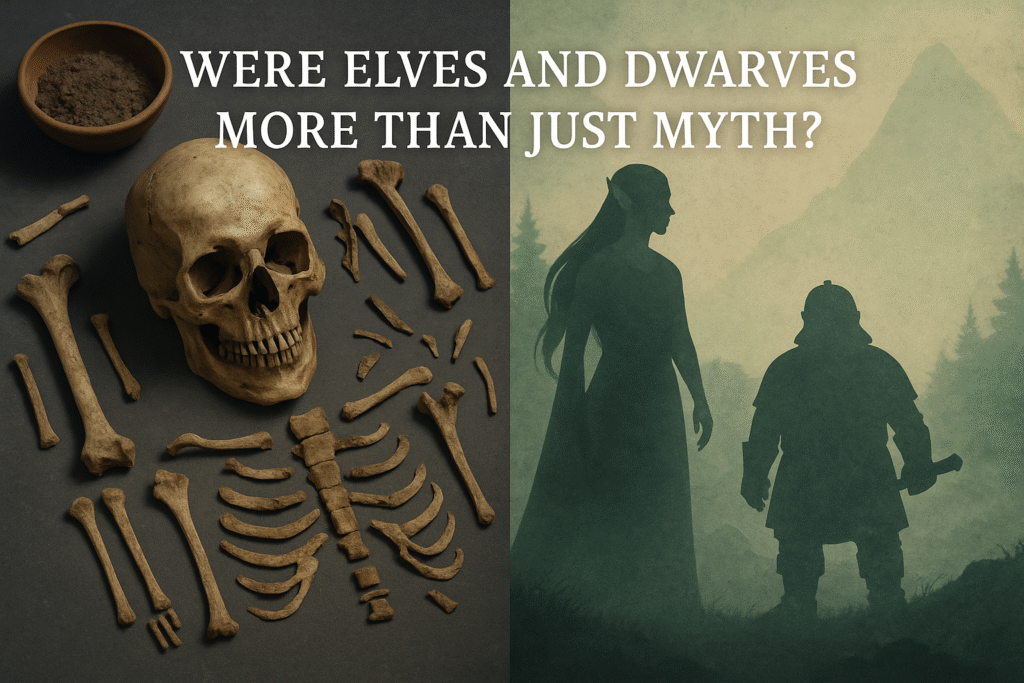
What if those ancient stories were actually blurry memories of real, forgotten beings?
Let’s say elves and dwarves were real — not Tolkien characters, but actual ancient beings who once walked the Earth.
How would we even know?
If we found their bones today, would we recognize them as something other than human? Probably not. That’s the thing — if their skeletons were even slightly humanlike, they’d get lumped into the “another type of early human” category without a second thought. No glowing eyes. No pointy ears. No forest magic. Just a skull and some molars, filed away as another “Homo-something” species.
But here’s the kicker: we already do that.
We’ve found pinky bones and teeth and used that to name whole lost species like Denisovans. We’ve unearthed three-foot-tall humans (Homo floresiensis) and said, “Yeah, probably just an evolutionary offshoot.”
But why don’t we ever ask:
Hey, could this be the source of the dwarf legends?
The answer is frustratingly simple: because modern science and myth don’t play on the same team anymore. We’ve built this wall where one side studies facts, and the other just “tells stories.”
But what if some stories are facts — just told in the language of the past?
It wasn’t always like this. We used to chase myths. Entire expeditions launched for the lost city of Troy, Atlantis, and El Dorado.
Now? Myth is entertainment. Science is sterile.
And the juicy middle — where we ask “what if the legends were real?” — that space is left empty.
But look a little closer, and cracks start to appear in that wall:
Massive underground cities that shouldn’t exist
Megalithic stonework we still can’t recreate
Isolated tribes with unique DNA and features
Ancient writings and oral traditions across totally different continents that describe eerily similar beings — short, strong miners, tall, glowing forest dwellers
At what point do we stop calling it coincidence?
There are still some big questions I didn’t even get into here — but honestly, I think they’re worth asking:
Could the skeletons and myths be talking about the same beings?
Why does modern science keep legend and evidence in separate boxes?
Are we ignoring something important — maybe even intentionally?
And then there’s the quiet truth that’s kind of hard to ignore:
There are researchers and explorers out there trying to connect these dots, trying to see if myths like elves and dwarves have historical roots.
So why doesn’t anyone talk about them?
If any of that sounds interesting, maybe we’ll dig into those questions next.
🧠 Final Thought
Science is a tool — not a boundary.
If we want the full picture of human history, maybe we need to stop drawing such a hard line between stories and skeletons.
What if the past was far stranger — and more magical — than we’ve allowed ourselves to believe?
Discover more from Michael Allen
Subscribe to get the latest posts sent to your email.