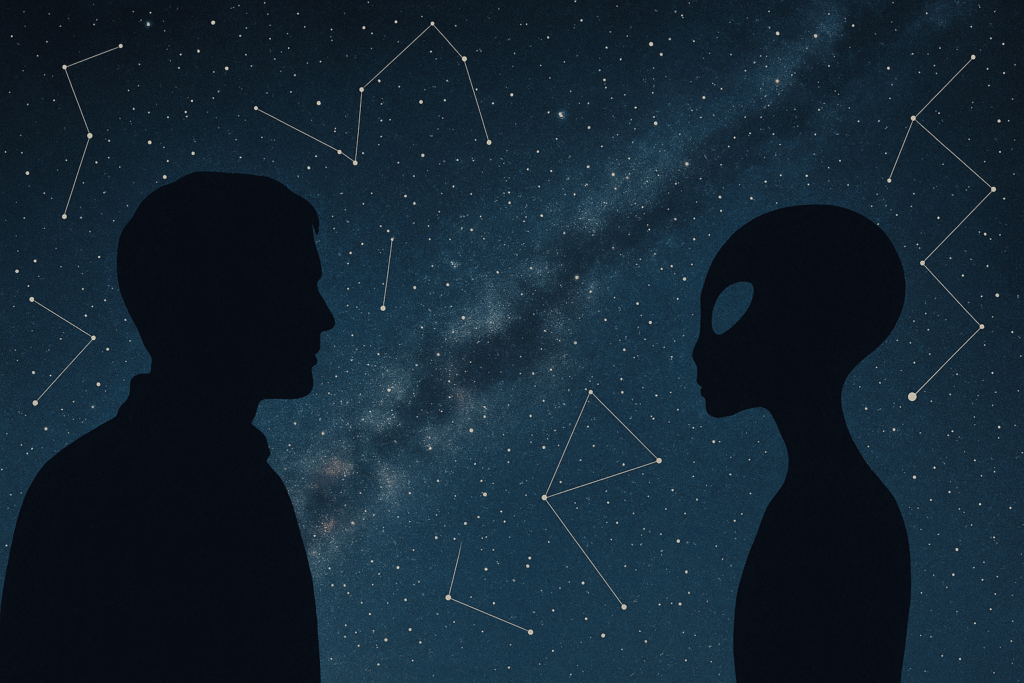
We’re used to naming everything. Planets. Beings. Galaxies.
But what if someone’s doing the same—to us?
Martians from Mars.
Venusians from Venus.
Klingons from Qo’noS.
Lyrans, Arcturians, Andromedans — sci-fi is packed with names we’ve made up for life beyond Earth.
But what if some other civilization out there was doing the exact same thing… to us?
What if, right now, some distant planet looks up at our Sun and has their own name for it — and their own word for us?
🌌 Could our Sun be part of a constellation — from another planet’s perspective?
Definitely.
Constellations aren’t real “groups” of stars in space. They’re just shapes we see in the sky — like dot-to-dot drawings. From Earth, we see patterns like Orion, Taurus, and the Big Dipper. But move to a different star system, and the stars shift. New shapes form. Ours disappear.
To them, our Sun would be just another point of light — unremarkable, distant, anonymous.
Let’s say you’re on a planet orbiting Alpha Centauri, the closest star system to us (just over 4 light-years away). You look up and see a completely different set of constellations. The Sun — our Sun — might be part of a pattern your people call The River Fang or The Ember Spine.
And if you’re the kind of civilization that names other planets or species based on those patterns…
Well, we’d get a name too.
🌠 We name them… so they’d name us
Let’s be honest — humans love naming stuff.
We’ve already got names for tons of alien civilizations, whether real, rumored, or just imagined:
- Andromedans – beings supposedly from the Andromeda Galaxy
- Pleiadians – from the Pleiades, a small star cluster also called the Seven Sisters
- Arcturians – from Arcturus, one of the brightest stars visible from Earth
- Zeta Reticulans (Greys) – the classic big-eyed aliens from Zeta Reticuli
- Nordics – sometimes linked to Aldebaran, a bright orange star in Taurus
These are names we’ve either imagined or pulled from UFO and sci-fi lore.
But the point is: we assign identities to beings based on where we think they come from.
Now flip the lens.
To someone on a planet in the Pleiades, our Sun might look like part of a totally different constellation. Maybe they’d call our region of space something like Velkara.
And they’d call us Velkariens.
Or Solans, if they used our star’s Latin name, Sol.
Or maybe something entirely unique—shaped by how we appear in their sky.
📜 What if they already named us long ago?
Here’s a fun twist: maybe we’ve already heard some of the names others had for us.
Some of the oldest words humans used to describe themselves are pretty strange by today’s standards:
- The Sumerians called themselves sag-gig-ga, meaning “black-headed people”
- The ancient Egyptians called themselves rmṯ, meaning “the people”
What if — just hypothetically — those names were actually translations of how other civilizations once referred to us?
Passed down through early contact?
Then reinterpreted as myth or religious stories?
Again — no proof. But it’s fun to wonder.
🛸 From the Outside Looking In…
From our point of view, we’re the center of the story.
We build star charts, name exoplanets, imagine alien empires.
But somewhere out there, we’re just another star.
Just another faint dot in someone else’s sky.
They might be asking the same questions:
Who lives there?
What are they like?
Do they know about us?
✨ Takeaway
We’re always trying to name and understand the universe.
But maybe someone’s already named us — and mapped our Sun into their own sky charts.
The real question isn’t “What would we call them?”
It’s what do they already call us?
Discover more from Michael Allen
Subscribe to get the latest posts sent to your email.