
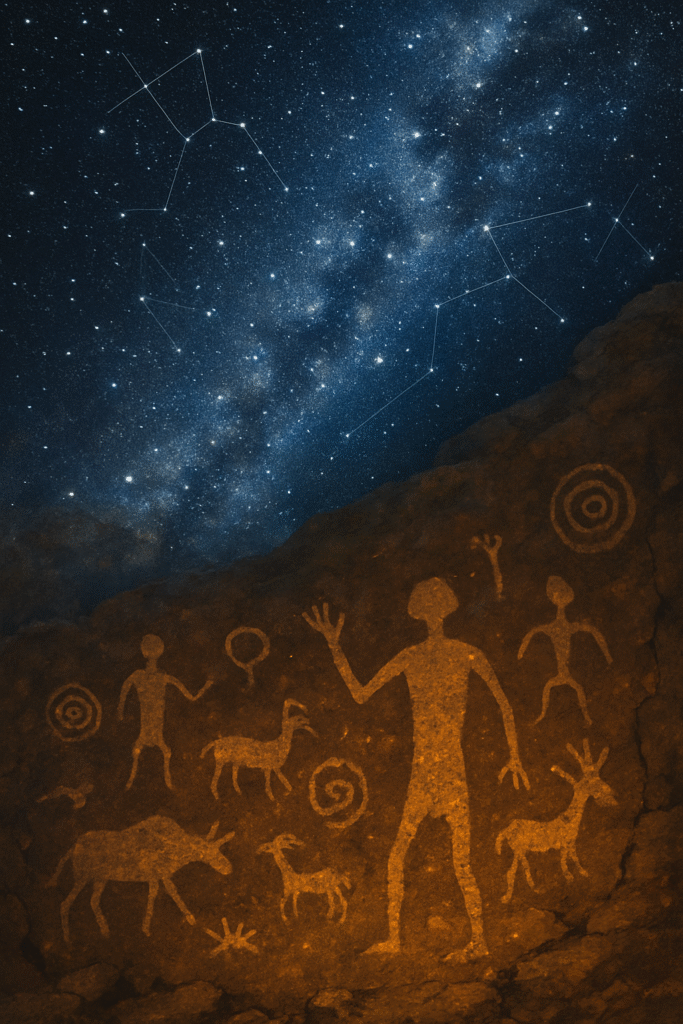
Have You Ever Wondered If Earth’s Oldest Myths Came from the Stars?
Let’s go on a little mental field trip — the kind where you’re sitting still, but your brain travels across ancient civilizations, mythologies, and maybe even… other worlds.
It started with a question: what’s the oldest creation myth?
Most historians will tell you the Sumerian creation myth is the oldest written one — around 2600 BCE — involving a watery chaos, sky gods, and humans made from clay to serve divine beings.
But older oral traditions likely go back tens of thousands of years — passed down through generations before writing was even a thing.
Here’s a quick spin through some of the big ones you may not have heard of:
🐍 Australian Aboriginal Dreamtime
The Dreamtime is not a single story, but an entire spiritual framework — possibly dating back 40,000+ years.
According to Aboriginal lore, ancestral beings emerged from the earth and sky, shaping the land, rivers, animals, and people. Time doesn’t flow linearly in Dreamtime — it’s a sacred dimension that exists alongside the present.
Creation comes from action, movement, and storytelling, not a god snapping their fingers. And the Earth itself is seen as alive — with every rock, stream, and tree holding part of that ancestral energy.
🌍 San People of Southern Africa
The San, one of the oldest continuous cultures on Earth, believe in a creator named Kaggen — often taking the form of a mantis, who uses trickery, transformation, and balance to shape the world.
Their stories aren’t about dominance or hierarchy, but balance between chaos and nature. Creation isn’t one big bang — it unfolds through small, symbolic acts: a rainmaker here, a lesson in hunting there. Every myth has a lesson.
🐢 Native American Earth Diver Myths
In many Native American traditions — particularly among the Ojibwe, Iroquois, and others — the world began covered in water.
A god or powerful being dives into the depths to retrieve mud or earth, which becomes the land. Sometimes it’s an animal who succeeds — like a turtle or a muskrat — not the most powerful being, but the most persistent.
That land is placed on the back of a turtle, giving rise to the phrase “Turtle Island” — still used by some Indigenous peoples to refer to North America.
🥚 The Cosmic Egg in Hindu and Chinese Myths
In Hindu mythology, the universe is born from a golden cosmic egg called Hiranyagarbha, which breaks open to become the heavens and the earth.
Similarly, in Chinese myth, there’s Pangu, a giant who hatches from a cosmic egg and separates Yin and Yang, becoming the land, sky, and all things when he dies.
The pattern?
Creation is personal, physical, and intimate.
The universe isn’t just “made” — it’s lived into existence.
But here’s where it gets interesting:
What if some of these names — like Ki (Sumerian Earth goddess) or rmṯ (how ancient Egyptians referred to themselves) — weren’t entirely homegrown?
What if, hypothetically, early humans interacted with visitors from elsewhere — maybe even civilizations that had their own names for our planet, our species, and our place in the cosmos?
And as oral traditions passed down those stories, maybe those names stuck — just buried under layers of translation, symbolism, and time.
It’s speculative, yes. But when you’re reading ancient stories full of beings descending from the sky to teach humans, measure stars, or shape life out of dust…
You have to wonder:
Were they gods?
Or were they simply explorers from another world?
🌀 Takeaway
Whether humanity’s oldest myths came from the stars or our own dreams, the fact that so many of them echo the same themes — across time and across cultures — makes you wonder what we once knew.
Maybe we just forgot the details—or buried them in story.
Discover more from Michael Allen
Subscribe to get the latest posts sent to your email.